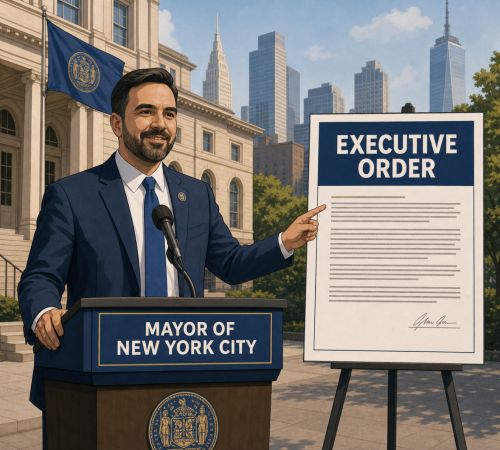
Starting July 20, 2026, New York City introduced a new initiative called OPEN for Small Business under Executive Order No. 18. The order is intended to reduce red tape and improve service for small businesses, especially during permitting, inspections, and compliance support. It does not erase DOB* violations or fines, but it may make it easier for owners to understand what the City is asking for and how to respond.
How the New Executive Order Helps Small Business Owners in NYC
If you are a hardworking small business owner dealing with DOB notices, open violations, or other agency issues, this order is worth understanding. It also matters for owners who are trying to open, expand, or regularize a storefront and need clearer guidance from the City. This order will not magically erase your penalties. But it does introduce a few tools you should know about – especially if you already have a DOB summons, open violations, or feel mistreated by inspectors.
Full text of the Executive Order:
The full text is written in legal language and can be difficult to follow without context. If you like details, here is the original document from the City of New York:
What EO 18 changes
One major change is the expansion of the NYC Business Express Service Team (NYC BEST) into a more hands-on support system for small businesses. In practical terms, that means owners may get help identifying required licenses and permits, coordinating inspections, and tracking applications across agencies.
DOB* is not the only agency involved. In this special executive order from the mayor, you can see several other city agencies mentioned: the Department of Consumer and Worker Protection (DCWP), the Department of Environmental Protection (DEP), the Fire Department of New York (FDNY*), and the Department of Health and Mental Hygiene (DOHMH). Other agencies include the Law Department, the Department of Parks and Recreation (DPR), the Department of Sanitation (DSNY), the Department of Transportation (DOT*), the Mayor’s Office of Operations, and the Chief Counsel to the Mayor and City Hall.
What Small Businesses Should Do Now
1. New “Concierge” Service: Help With Permits, Inspections, and Paperwork
The order expands the role of the NYC Business Express Service Team (NYC BEST) into a kind of concierge service for small storefront businesses. Each client should get a dedicated project manager who helps identify all required licenses and permits, coordinate pre‑opening inspections, and track the status of applications across multiple agencies.
For owners struggling with violations, this is important because:
- A single SBS contact should help you understand which agencies are involved in your case (DOB, FDNY, DOHMH, DSNY, DOT, etc.) and how their processes connect.
- The project manager can warn you about common mistakes that cause delays, re‑inspections, or extra penalties before you open or expand your business.
2. Creation of a Small Business Working Group
EO 18 also sets up a Small Business Working Group led by SBS and the Deputy Mayor for Economic Justice. This group will meet regularly to talk about ways to make city rules, inspections, and support for small businesses work better for everyday New Yorkers.
Key points for violation‑weary owners:
- This education is not available before complaint‑based or follow‑up inspections – so it will not soften the blow if a neighbor has already reported you.
- It can help you avoid the first wave of violations and summonses by explaining, in plain language, what the inspector will expect and how to document that you corrected issues.
On Iqarius, we can, review your existing DOB/FDNY/DOHMH history and help you decide whether asking for this compliance education makes sense in your situation. Also we can help you prepare a simple checklist and photo/document pack so that, when SBS or another agency comes for “education,” you can demonstrate progress instead of just receiving general advice.
3. Pre‑Adjudication Help to Resolve Summonses and Violations
The most relevant part for people drowning in violations is Section 1(c) of EO 18: SBS must provide pre‑adjudication assistance. In practice, that means guiding business owners on:
- Whether a violation is curable, and what steps must be taken to cure it.
- Options to settle or resolve a summons before an administrative hearing.
- What actions can bring you into compliance and how to respond to the summons at OATH or another tribunal.
This is where the order comes closest to your world: owners who are navigating multiple DOB notices, hearing dates, and different agencies. However, it still leaves many questions unanswered.
On Iqarius, we already specialize in decoding DOB and related violations. We can work with you to:
- Organize your violation history and identify which items are likely curable versus those that probably require hearings or permits.
- Prepare a concise case summary you can bring to SBS so their pre‑adjudication assistance becomes concrete, not just generic talking points.
4. Business Owner Bill of Rights: Inspectors Must Hand It to You
Beginning October 1, 2026, inspectors from DOB, DCWP, DEP, FDNY, DOHMH, DPR, DSNY, and DOT must hand you a physical copy of the Updated Business Owner Bill of Rights at the start of every onsite inspection of a storefront business. They must also tell you how to access translations and the Customer Service Survey in all designated citywide languages.
For everyday owners, this matters because:
- You can see, in writing, what standards of behavior inspectors must follow – respect, fairness, and consistency are not just slogans but part of the Charter.
- If an inspector ignores those rules, you have a document you can reference in complaints or appeals, rather than relying only on memory.
5. Continuous‑Improvement Group: Watching Violations and Default Rates
EO 18 also sets up a Small Business Working Group led by SBS and the Deputy Mayor for Economic Justice. This group will meet regularly to talk about ways to make city rules, inspections, and support for small businesses work better for everyday New Yorkers.
- Process improvements to reduce pain points in licensing and permitting and shorten processing times.
- Training and quality control to eliminate inconsistent enforcement guidance and improve compliance education.
- Ways to increase compliance rates for frequently issued violations and decrease default rates at administrative hearings.
From the homeowner’s perspective, this is still more of a political gesture than a structural change: the same agencies keep their enforcement powers, but they now wrap them in a “rights” document. On Iqarius, we can walk through that Bill of Rights with you and show which clauses matter in DOB building violation cases, not just in retail or food service settings.
This is where the order admits that many owners simply never make it to hearings or do not understand how to defend themselves. The Working Group is asked to look at default statistics and propose changes. From a practical point of view, this is an opportunity to push for:
- Better multilingual information for small business and property owners.
- Clearer notices explaining what happens if you ignore a summons, and how to cure violations step by step.
This support does not replace professional code advice, but it gives you a clearer “map” of the bureaucracy. On Iqarius, we can help you prepare questions and documents before you talk to NYC BEST, so you use that concierge time effectively rather than getting lost in general explanations.
Iqarius can act as a practical bridge here: collecting real‑world stories from owners (especially homeowners and small landlords) and translating them into patterns that show where the system fails ordinary people, not just restaurants and boutiques.
Affordability and Politics: What EO 18 Does Not Fix
The order explicitly mentions the affordability crisis: even if owners “do everything right” with the City.
EO 18 is not a financial relief program. It does not remove DOB fines on its own, and it does not solve the broader cost pressures many owners face, such as rent, insurance, utilities, and vacancy concerns.
It is better understood as a process improvement measure than a penalty-reduction measure. For many owners, that still matters, because clearer instructions and better coordination can reduce delays, missed deadlines, and repeat violations.
This is especially relevant for readers who deal with building issues, permit questions, inspections, and violations. In many cases, the hardest part is not only the fine itself. The harder part is figuring out what the city expects next. A clearer process can help owners stay organized, respond faster, and keep their business running. For a small business, that kind of support can make a real difference.
Need help using these new tools? How Iqarius can help
If you are trying to make sense of DOB notices, agency letters, or upcoming hearings, Iqarius can help you turn scattered paperwork into a clear action plan. We offer case organization, plain-language guidance, and a free 15-minute online consultation to review your situation step by step.
- Case organization session – turning scattered letters, e‑mails, and fines into a timeline and document pack you can use with SBS, NYC BEST, or your attorney.
- Plain‑language guidance – explaining DOB, FDNY, DOHMH, and other agency requirements in simple, practical English so you understand what the City is really asking for.
- Free 15‑minute online consultation – we review your notices, violations, and upcoming hearings step by step.