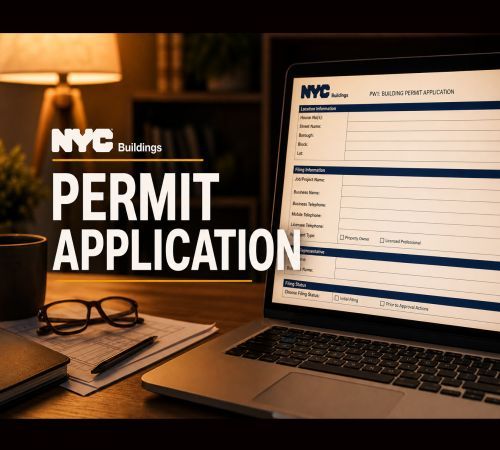
A DOB permit application, also called a filing, is the record submitted to the Department of Buildings for proposed work. If DOB approves the filing and all permit requirements are met, DOB may issue the permit authorizing the work. The work must then be completed, inspected, and signed off before the job can be fully closed.
An open DOB job filing or permit is a record that has not yet reached its required final status in DOB’s system. It may be open because it is still under plan review, has unresolved objections or required documents, has not progressed to permit issuance, or has an issued permit that was never fully inspected and signed off.
How to open a permit application and check its status
To start a new permit application, log in to DOB NOW: Build and create a filing for the proposed work. Enter the required property and job information, add the required parties, and upload the documents required for the filing type. If DOB requests corrections, signatures, or additional documents, complete those items before the filing can move forward. After submission, check the filing status in DOB NOW or the DOB Public Portal to see whether it is in progress, under review, approved, awaiting corrections, or otherwise requires action.
Most newer filings appear in DOB NOW, while many older records remain in BIS. If you do not find a job in one system, check the other system as well.
Important: An application is not the same as a permit
In NYC DOB records, the terms job, filing (or application), and permit are related but not interchangeable. A job is the overall DOB record for construction work and can contain one or more filings. A filing or application is submitted for DOB review; a permit is DOB authorization to perform approved work. Each filing may require its own approval and permit.
An application may remain open during plan review, while objections or required items are outstanding, or after a permit has been issued but not signed off. Do not assume an expired permit means the DOB record is closed. Check the status of the specific job, filing, and permit, including whether the permit is signed off and whether DOB issued the appropriate final close-out document.
Common Reasons Applications Stay Open
Open DOB job filings and permits are often caused by missed paperwork, changes in plans, incomplete work, uncompleted inspections, or a missing final sign-off. An open record does not always mean there is a violation, but it can indicate that DOB still requires action before the filing can be closed.
Open DOB records can become a practical problem when you sell, refinance, obtain title or lender review, or plan additional work. They may reveal unfinished compliance, inspection, documentation, or permit requirements that should be addressed before a transaction or a new filing.
A property can have multiple open DOB records, each with its own job number, filing number, or permit number. Review and resolve each record individually; closing one job does not automatically close another.
- No approval received: The applicant of record submitted the filing but did not complete required corrections, signatures, documents, or other steps needed for DOB approval.
- Filing approved but permit not obtained: DOB approved the filing, but the required permit was never requested or issued because plans changed, costs increased, or the project was postponed.
- Work started but unfinished: Construction began but was not completed, often because the project was delayed, funding changed, or required inspections were not completed.
- Work completed but no final sign-off: The physical work may be finished, but final inspections, technical reports, affidavits, or other required documents were not completed or submitted to DOB.
The correct solution depends on what happened. If work was completed as approved, the job may need final inspections, technical reports, missing documents, and permit sign-off. If work never began, withdrawal may be appropriate. If work was partly completed or differs from the approved plans, a registered design professional should review the conditions before a close-out request is made.
Homeowners can research a record through DOB NOW and BIS. The correct resolution depends on the job’s status and the work completed: it may involve submitting missing documents, resolving objections, obtaining a permit and final inspections, withdrawing a filing that will not proceed, or completing the applicable sign-off process.
Why an Open DOB Record Can Matter to Property Owners
An open DOB job filing or permit can complicate a property sale, refinancing, title review, or future construction plans. Buyers, lenders, attorneys, and design professionals may need to determine whether the work was completed, whether permits were signed off, and what steps remain to close the record.
Steps to take
You may see references to open applications, open jobs, or open permits. In everyday NYC real-estate language, these phrases often mean there is unfinished DOB business, whether on the filing side, construction side, or sign-off side. Check the actual DOB record to identify the specific job, filing, permit, and outstanding requirement.
- Check the property record in both DOB NOW and BIS, particularly when the work may be from different periods.
- Record the job number, filing number, permit number, filing status, permit status, objections, required items, and inspection history before deciding on the next step.
- Learn which close-out process applies to the record. For an eligible DOB NOW: Build job, an owner or applicant of record may request a Letter of Completion (LOC) after required filing, permit, inspection, and document items are completed. For an older BIS job, an LOC request is generally submitted through eSubmit using Form PW7 with any remaining required items. A project that requires a new or amended Certificate of Occupancy follows the Certificate of Occupancy process instead.
- Consult a qualified registered design professional, licensed contractor, or DOB filing professional when the work was never completed, differs from approved plans, has unresolved objections, or requires technical reports or inspections.
Addressing open DOB records early can make future construction, property transactions, and compliance reviews more manageable. Start by identifying the exact record and remaining requirements instead of assuming that an old or expired permit has been closed.
Revised

