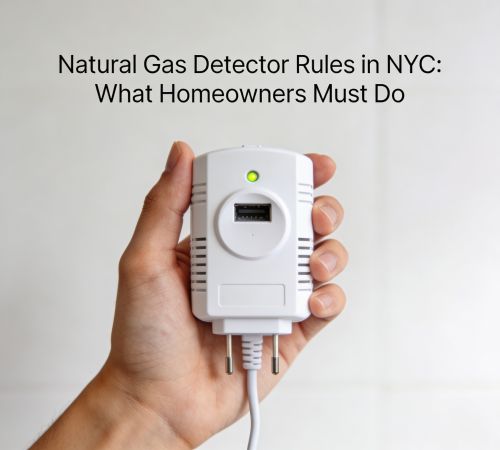
Many covered NYC residential properties with gas service or gas piping must have approved natural gas detecting devices, commonly called natural gas alarms, under Local Law 157 and related NYC rules.
The installation deadline for covered properties is January 1, 2027. DOB has confirmed that it identified at least four distinct manufacturers of qualifying battery-powered natural gas alarms, so the deadline will not be extended beyond January 1, 2027.
If your NYC residential property has gas service or gas piping, do not wait until the last minute. Local Law 157 requires covered owners to provide and install approved natural gas detecting devices by January 1, 2027. The law applies to covered private dwellings and multiple dwellings, with specific rules for Class A and Class B buildings. This guide explains the rules in plain language so small property owners and apartment residents can quickly see whether the law may apply to their building, what type of device may be acceptable, and what steps to take to help stay compliant and safe.
Owner obligations and covered buildings: What the rules are, who they cover, and what you should do
New York City’s natural gas detector law, Local Law 157 and its implementing rules, requires owners of covered residential buildings with gas piping or gas service to provide and install approved natural gas detecting devices, also called natural gas alarms. The installation deadline for covered properties is January 1, 2027. DOB has confirmed that the deadline will not be extended. Owners must:
- Determine whether the building has gas piping or gas service and whether it is a covered private dwelling, Class A multiple dwelling, or Class B multiple dwelling.
- Provide and install one or more approved and operational natural gas detecting devices as required for the building and dwelling unit.
- Locate devices in accordance with applicable DOB rules, the manufacturer’s installation instructions, and other applicable standards.
- Maintain and replace devices when their manufacturer-stated useful life expires and follow applicable DOB requirements.
- Give at least one adult occupant information about gas leak risks, device testing and maintenance, what to do when an alarm sounds, and the device’s useful life.
Does this law apply to my home?
In practice, the requirement may apply to:
- Certain private dwellings with gas piping or gas service, including applicable one- and two-family homes. The exact requirement can depend on occupancy, where gas service enters the building, the location of gas-burning appliances, and applicable Building Code provisions.
- Class A multiple dwellings with gas piping or gas service.
- Class B multiple dwellings, such as hotels and certain lodging houses, with gas piping or gas service. Depending on the building configuration and applicable code provisions, a qualifying line-operated zoned natural gas detection system in public corridors or public spaces may be permitted.
- A building without gas piping or gas service is generally outside the natural gas alarm requirement. Owners should still confirm the building’s actual conditions, occupancy classification, and current NYC rule text before relying on an exemption.
Required location and installation rules
Natural gas alarm placement is not a one-size-fits-all rule. The correct location depends on the type of device, the room layout, gas appliances or gas-service entry points, the applicable NYC rule, and the manufacturer’s instructions. For each covered dwelling unit or required area, use an approved device and follow the installation instructions that apply to that device and location. Basic placement points include:
- Do not rely only on a general “3 to 10 feet from the appliance” rule. Follow the device manufacturer’s instructions and applicable NYC placement requirements.
- If a room cannot meet the normally required separation from a fuel-gas-burning appliance, follow the device manufacturer’s instructions and the applicable NYC placement rule.
- Do not assume that one device automatically covers every gas appliance, room, basement, corridor, or dwelling unit. Placement must match the building conditions and the applicable rule.
Important: Common areas such as shared basement laundry rooms, gas-dryer areas, boiler rooms, and corridors may have different requirements from dwelling units. Do not assume that a common space is exempt or that a dwelling-unit alarm satisfies every building-wide requirement. Confirm the building classification, gas equipment and service locations, and the applicable NYC rule before deciding what is required.
What type of detector is acceptable?
Owners must use approved natural gas detecting devices that are suitable for the required NYC installation. Before purchasing or installing a device, read the product documentation carefully and confirm that it is designed for natural gas detection and suitable for the intended location. At minimum:
Check the required listing and label. NYC requires natural gas detecting devices to be listed and labeled to the applicable standard. Check the product packaging, instruction sheet, and the label on the device before buying or installing it. Do not assume that every gas detector sold online meets NYC requirements.
- The device must be listed and labeled for natural gas detection and suitable for the particular NYC installation.
- The device must meet applicable listing, approval, and installation requirements. Do not assume that every consumer gas detector sold online qualifies.
- Follow the manufacturer’s instructions for location, power source, testing, maintenance, replacement, and useful life.
- A combination smoke, carbon monoxide, and gas device may be used only when it independently meets the applicable requirements for each function, including natural gas detection.
Who may install the detector?
- Battery-powered and plug-in AC-receptacle natural gas alarms may be installed by the owner, building maintenance personnel, or an occupant when installation follows the manufacturer’s instructions and all applicable NYC requirements.
- Hard-wired alarms and electrical work that require a permit must be installed by a NYC Licensed Electrical Contractor.
Owners should not modify, open, or alter any listed device. Follow the manufacturer’s instructions for testing, maintenance, replacement, and end-of-life disposal.
For questions about the citywide deadline or Local Law 102 of 2025, DOB directs owners to email LL102of2025@buildings.nyc.gov.
Revised