ECB/OATH Violations – What the Environmental Control Board Can Do to You
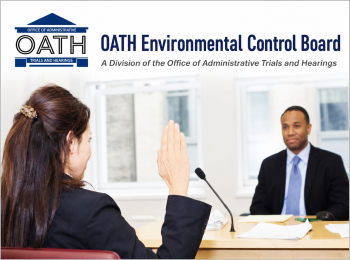
An ECB violation (now called an OATH* summons) is a ticket issued by a New York City agency that tells you to go to a special city court on a set date and time. At this hearing, a judge decides if you must pay a fine and how much.
Common ECB violations for homeowners include not fixing mold or water damage, doing construction without a permit, blocking an exit, or not having required smoke or carbon monoxide detectors. These problems can affect health and safety for the people living in the building.
By contrast, a DOB violation letter looks more like a separate notice from the NYC Department of Buildings. It typically does not list a hearing date because DOB violations are handled directly with the Department, not at an ECB/OATH hearing.
How to check specific codes included in your ECB violation?
What ECB really is
The Environmental Control Board (ECB) is part of the NYC Office of Administrative Trials and Hearings (OATH). It holds hearings for tickets written by city agencies such as the Department of Buildings (DOB), Department of Environmental Protection (DEP), and the Fire Department (FDNY)
ECB does not send inspectors or write violations itself. It acts as a neutral city office where a judge reviews these cases. ECB decisions can affect your wallet, your ability to sell or refinance your property, and even your right to legally occupy your home if problems remain open.
In simple words
- ECB is a city office where a judge decides if you must pay a fine for a violation.
- An ECB/OATH summons is a ticket that tells you to go to a hearing on a specific date.
- If you fix the problem and follow the instructions, you can often reduce or avoid extra penalties.
What ECB Does
- Violations can be issued by agencies like the Department of Buildings (DOB), Department of Environmental Protection (DEP), Department of Sanitation (DSNY), Department of Health (DOHMH), Department of Transportation (DOT), Parks Department or Fire Department, and handled in hearings organized by ECB.
- Common violations for homeowners may include failure to address mold, not installing proper smoke detectors, and other infractions affecting health and safety.
Implications for Homeowners
ECB reviews local law violations such as improper or unpermitted work, unsafe scaffolding, missing smoke or carbon monoxide detectors, and environmental hazards like mold or air pollution.”
Unresolved ECB violations can lead to additional fines, liens against your property, trouble with selling or refinancing, and possible problems with your Certificate of Occupancy or insurance coverage. Homeowners are responsible for correcting violations promptly, keeping proof of the correction, and following agency instructions to close the case fully
Statement in Support of Certificate of Correction (plain‑legal definition)
Statement in Support of Certificate of Correction
A Statement in Support of Certificate of Correction is a written explanation that a property owner (or their representative) submits to the City together with the Certificate of Correction form. In this statement, the owner describes what caused the violation, what work was done to correct it, and when the correction was completed. The document often includes details about permits, contractors, and inspections and may attach photos or other proof.The City reviews this statement to decide whether the violation has been fully corrected and can be closed, and whether any penalties or defaults should be reduced or dismissed. It is especially important when the owner is asking to vacate a default decision or to get mitigation of civil penalties.
How to Handle an ECB Violation
Make the required corrections, gather proof (photos, permits, sign‑offs), and submit any required certificates or forms to the agency and, if needed, to the ECB/OATH hearing office so the City can close the violation. You can also look up the specific violation code on our NYC Violation Codes HUB to see which forms the agency usually requires.
Stipulation – an agreement instead of a full hearing
For some DOB/OATH summonses, the City may offer you a stipulation agreement. This is a written agreement where you admit the violation instead of fighting it in a full hearing, but in exchange you usually:
- Get extra time (often about 75 days) to correct the problem and file a Certificate of Correction with DOB.
- Pay a reduced penalty, often about half of the normal fine, as long as you correct the condition on time.
A stipulation can be offered in a letter before the hearing or when you appear at OATH on the hearing date. If you accept a stipulation but do not correct the violation and send proof by the deadline, you can lose the discount and may have to pay the full penalty.

NEXT STEP
See how to solve Violations in real NYC examples

Good to know
This page is for general education only and is based on public New York City sources when available. Some technical and legal terms are simplified into plain English to help homeowners and ESL readers. It is not legal advice, and it does not replace guidance from a licensed professional. NYC construction and safety rules change often, and your project may have extra DOB*, OSHA*, or local requirements. Before you start work, always check current rules with a licensed design professional or directly with the NYC Department of Buildings.
Feel free to comment on this post
This is an advertisement box

If you see any capital letter abbreviations on this page or in an official letter you received from the city and you do not understand them, you can try to look them up on our NYC Violation Codes HUB page with the search tool.
Revised