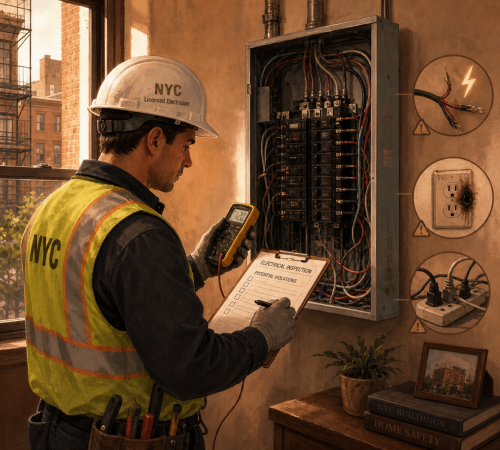
Typical Electrical Violations for NYC Homeowners
If you own a 1–4 family home in New York City and you have received a violation notice related to electrical work — or if an inspector, tenant complaint, or building sale has surfaced an open issue — this page explains, in plain language, what the violation means, why it happened, and how to close it through the DOB* correction process.
What Is an NYC Electrical Violation?
Electrical violations in New York City are issued by the DOB* when wiring, panels, outlets, or electrical systems in a building do not meet the NYC Electrical Code. They can appear in your property record in BIS* or DOB NOW as open items attached to your address. These often show up during inspections, tenant complaints, or building sales, and they can cause fires, shocks, or big fines.
Common Electrical Violations in NYC Homes
- Unsafe wiring: Exposed wires, DIY fixes like taped connections, or wrong-sized cables running through walls without protection—these create shock or fire risks.
- Overloaded circuits: Too many appliances (like heaters or chargers) on one breaker, or using extension cords and power strips as permanent wiring, which overheats lines.
- Missing GFCI and AFCI protection: No GFCI outlets (which cut power if water touches them) in kitchens, bathrooms, garages, or outdoors; no AFCI breakers in bedrooms and living rooms as required by code.
- Electrical panel problems: Blocked panels, unlabeled breakers, loose ground wires, or insufficient clearance in front of the panel.
- Work without a permit: Outlets added, panels upgraded, or new circuits installed without DOB approval, often by an unlicensed handyman instead of licensed pros.
How to Look Up Your Electrical Violation
Before you do anything else, check your property record:
- Step 1 — Look up your address in BIS* (Buildings Information System) or DOB NOW to see all open violations linked to your building.
- Step 2 — Find the violation number and description. Electrical violations issued by the DOB appear as DOB violations; those referred to OATH* for a hearing appear as ECB* (Environmental Control Board) violations.
- Step 3 — Note any scheduled hearing dates. ECB/OATH summonses have deadlines. Missing a hearing can result in a default judgment and higher penalties.
How to Correct and Close an Electrical Violation — Step by Step
- Step 1 — Hire a licensed NYC electrician. Make sure they hold a valid Master Electrician license. You can verify license status on the NYC DOB website. Confirm they will pull the permit in their own name — not yours.
Step 2 — Pull the required permit. All corrective electrical work requires a DOB permit filed through DOB NOW. No permit means the correction will not be accepted.
Step 3 — Complete the work to NYC Electrical Code. The licensed electrician performs and signs off on all required work.
Step 4 — File a Certificate of Correction. Once the work is done, your electrician (or a filing representative) submits a Certificate of Correction to DOB* to formally close the violation.
Step 5 — Verify the violation is closed. Check BIS* or DOB NOW again to confirm the violation status changed from “open” to “closed.”
If you are new to these terms, see our encyclopedia entries on DOB*, ECB*, BIS*, and DOB NOW for plain-language explanations.
Not sure what your violation means or what to do next?
Book a free 15‑minute consultation and we’ll walk through your violation case step by step. For a broader overview of how DOB violations work, see our guide: Get Help Correcting Your NYC DOB Summonses: Step‑by‑Step Guide for Brooklyn Homeowners.
ECB/OATH Consequences — What Happens If You Don’t Act
Open electrical violations that are referred to OATH* carry financial penalties:
Penalties can reach thousands of dollars, and they can grow if you miss your hearing or fail to correct on time.
Default judgments are issued automatically if you do not appear at an OATH hearing.
Stop-Work Orders can be placed on your property, blocking any other permit work or sales until the issue is resolved.
Open violations block sales and refinancing — title companies and mortgage lenders check BIS* records. An open ECB electrical violation can delay or kill a closing.
If you already have an open summons, see: Have an open DOB summons? Get help from the City.
Act Now or Wait? A Simple Rule
Situation: What to do:
Violation is open but no hearing date yet
Start the correction process promptly — don’t wait for a summons
ECB/OATH hearing date is set
Act immediately — missing the date triggers a default penalty
Planning to sell or refinance
Clear all open violations before listing or applying
Violation is old and you’re not sure it’s valid
Look it up in BIS first, then consult before paying anything
Don’t try fixes yourself
Call a licensed NYC electrician right away to check everything and make it safe. They’ll get any needed permits, do the work to match NYC Electrical Code, and file a “Certificate of Correction” with DOB to close the case. Act fast to avoid extra fees (up to thousands) or stop-work orders that halt repairs or sales.
Iqarius is an independent information and educational resource and is not part of NYC Department of Buildings, OATH*, or any City agency. All information on this page is provided for educational purposes only and is not legal advice.