Certificate of Occupancy (CO)
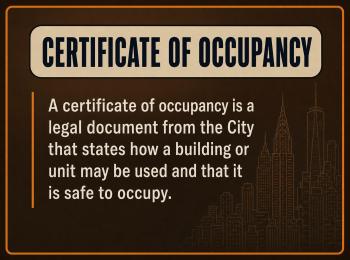
A Certificate of Occupancy (CO) is very important for a homeowner in NYC because without this document people are not allowed to live or work in the building. Without a valid CO, you cannot legally live in, rent out, or sell your property. It also shows that all construction or changes were done according to approved plans and permits, and that all required city fees and violations have been taken care of.
A Certificate of Occupancy (CO) is more than just another city form – it is the official permission for people to live in or use a building in New York City. Without this permission, you cannot legally live in, rent out, or sell your property, no matter how long the building has been standing. A valid CO (or a Temporary Certificate of Occupancy, TCO, while final work is still in progress) confirms that the basic rules for safe use and legal occupancy have been met.
If you change how the building is used – for example, turning a store into an apartment, or splitting one large apartment into two smaller ones – the City expects an updated or amended CO that matches the new reality on the ground. The CO also acts as a snapshot showing that construction or alterations were done under approved plans and permits, and that required city fees and outstanding violations were properly resolved.
Simple example – one short example:
If your CO says “2‑family house.” – That means the City only allows 2 separate apartments (2 separate living spaces) in this building. If you create a 3rd apartment in the basement and rent it, that extra apartment is illegal because it is not listed on the CO.
Quick Facts:
- Who gives the CO? – NYC Department of Buildings (DOB*).
- What does it say? – If the building is a 1‑family house, 2‑family house, apartment building, store, office, etc., and sometimes how many people or families can be there
- When do you need it? – Before anyone can legally live in or use the building.
- Why is it important? – It shows the building passed inspections and follows safety and zoning rules.
How to look up your CO
Go to NYC DOB BIS
- Visit the NYC Department of Buildings “Buildings Information System” (BIS).
- Search by house number and street, or by Block and Lot.
- On the Property Profile page, click “View Certificates of Occupancy” to see if a CO exists and download the PDF.
Check DOB NOW for newer buildings
- For newer construction and recent Alteration jobs, use DOB NOW and search by your address.nyc-business.
- On the Property Profile page, click “Certificate of Occupancy” to see details and floor‑use records.
If you don’t find a CO online
- If nothing appears in BIS or DOB NOW, the CO may not be scanned or may not exist.nyc-business.
- You (or your representative) can request records or a copy at the DOB Borough Office for your property’s borough.

NEXT STEP
See what a Certificate of Occupancy looks like in real NYC examples
Good to know
This page is for general education only and is based on public New York City sources when available. Some technical and legal terms are simplified into plain English to help homeowners and ESL readers. It is not legal advice, and it does not replace guidance from a licensed professional. NYC construction and safety rules change often, and your project may have extra DOB*, OSHA*, or local requirements. Before you start work, always check current rules with a licensed design professional or directly with the NYC Department of Buildings.
Feel free to comment on this post
This is an advertisement box

If you see any capital letter abbreviations on this page or in an official letter you received from the city and you do not understand them, you can try to look them up on our NYC Violation Codes HUB page with the search tool.
Revised