Letter of completion (LOC) and its importance
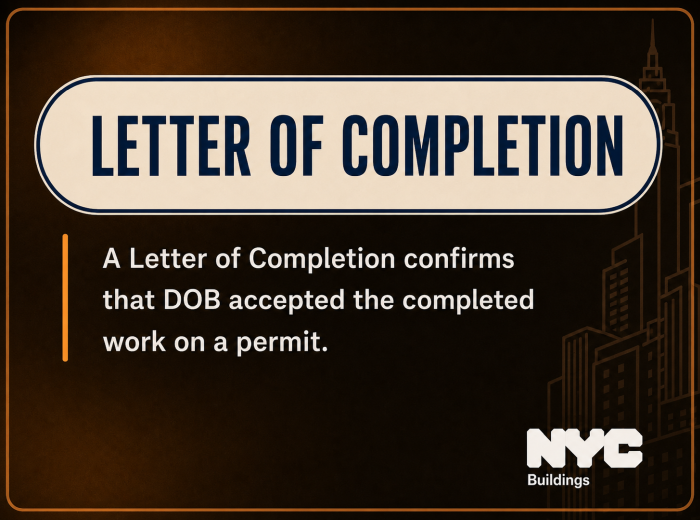
Letter of Completion (LOC) — A document issued by the NYC Department of Buildings (DOB*) after the required work, inspections, documents, and permit sign-offs for a job filing have been completed. An LOC is generally used for an alteration that does not require a new or amended Certificate of Occupancy (CO).
What information is on a Letter of Completion?
The exact format can vary depending on whether the job was filed in DOB NOW or the older Buildings Information System (BIS). An LOC commonly identifies the completed DOB job filing and shows that DOB has issued the Letter of Completion.
- Property information: The building address and, in some cases, related property identifiers.
- Job filing information: The DOB job, application, or filing number connected to the completed work.
- Type or description of work: A short description or work type associated with the filing.
- LOC status or issuance information: Information showing that the Letter of Completion was issued for the filing.
- Related filing details: Depending on the job, the record may also show permit, applicant, or filing information. Some details may appear in DOB NOW or BIS rather than on the LOC document itself.
Why it matters
For a homeowner, a Letter of Completion is proof that your permitted work was inspected and accepted by the DOB, even though your project did not need a new Certificate of Occupancy. Your contractor, applicant, or design professional may help complete the required sign-offs and documents, but the person allowed to submit the LOC request depends on the DOB filing and system.
For DOB NOW: Build jobs, the owner or applicant of record can request an LOC after the filing meets DOB’s completion requirements. For certain older BIS Alteration Type 2 and Type 3 filings, the request is made by uploading a PW7, Letter of Completion Request, through eSubmit. The exact process depends on the filing system and work type.
Finishing construction does not close your DOB job automatically. Even after your contractor finishes all the work, your job can stay “open” in DOB’s records until every required step is signed off. Here are the most common reasons an LOC gets stuck:
- One or more permits have not been signed off — all applicable permits associated with the filing must be inspected and signed off.
- Required inspections, technical reports, or special-inspection certifications are still open — this applies when those requirements are part of the filing.
- Final PW3 cost details were not verified or updated — DOB requires final-cost information to be verified before an LOC request.
- A required document is missing or incomplete — all required documents must be submitted before DOB can process the request.
- The completed work differs from the approved filing — changes may need DOB review, an amendment, or correction before the job can be signed off.
- A required permit has expired or has another unresolved status issue — the permit status may need to be corrected before final sign-off.
- A required applicant, contractor, inspector, or design professional certification has not been submitted — this can happen when a responsible party is unavailable or has not completed their filing task.
- The job uses a different filing process — DOB NOW and legacy BIS jobs have different LOC request procedures.

NEXT STEP
Learn how to request a Letter of Completion through DOB NOW
Good to know
This page is for general education only and is based on public New York City sources when available. Some technical and legal terms are simplified into plain English to help homeowners and ESL readers. It is not legal advice, and it does not replace guidance from a licensed professional. NYC construction and safety rules change often, and your project may have extra DOB*, OSHA, or local requirements. Before you start work, always check current rules with a licensed design professional or directly with the NYC Department of Buildings.
Feel free to comment on this post
This is an advertisement box

If you see any capital letter abbreviations on this page or in an official letter you received from the city and you do not understand them, you can try to look them up on our NYC Violation Codes HUB page with the search tool.
Revised