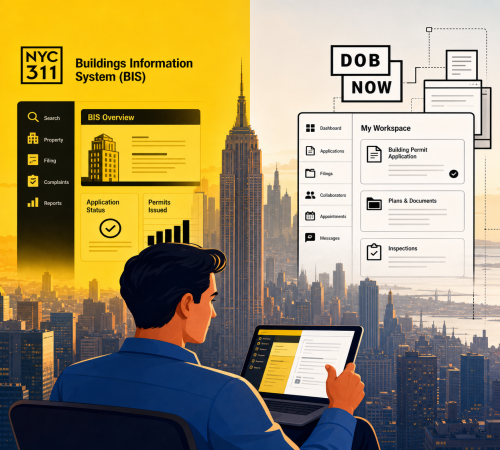
If you are here, you already know that the NYC Department of Buildings (DOB*) keeps a lot of information about every building. If you want to see what you can learn about your property, your current project, or your violation notice, read this guide. It focuses on two official DOB systems – BIS and DOB NOW – and helps you understand which one is better to use.
This is completely free, useful information. You can do it by yourself. In plain English we explain how to look up your own property, read the records, and ask better questions when talking to professionals.
NYC official lookup tools (core set)
- BIS* / BISWeb (Building Information System) – The older DOB database. It shows many historic records for a property, such as complaints, DOB violations, permits, inspections, and older job filings.
- DOB NOW* Public Portal – The newer DOB online portal. It shows many newer filings, permits, inspections, and other activity submitted through DOB NOW modules.
- Find Building Data / DOB lookup pages – DOB explains that building information may be split between BIS and DOB NOW, so owners often need to check both systems to see the full picture.
BIS vs DOB NOW at a glance
NYC DOB uses two systems side by side. BIS is the older record system for many past filings, and DOB NOW is the newer portal for many current filings and permit actions. Both are official and both matter, but they do not always show the same information.
If you look only at one system, you may miss something important – for example, an old violation in BIS or a new job filing in DOB NOW. The table below gives you a quick overview so you can see what each system is best for.
| Item | BIS (older system) | DOB NOW (newer portal) |
|---|---|---|
| Main focus | Historic building records: complaints, violations, older permits and jobs. | Many current filings, permit activity, inspections, and uploads. |
| Best use for owners | Checking long-term history and older DOB problems before buying or selling. | Checking what is happening now: recent work, permit steps, and inspection status. |
| Typical questions | “Does this property have old violations or past issues?” | “Is my contractor’s job really filed, approved, or still in review?” |
| Limitations | Does not show full detail for many newer DOB NOW filings. | Does not show full historic archive for many older building records. |
What BIS can do
BIS is useful when you want to see the history of a building. It can show older complaints, DOB violations, permits, inspections, and job filings connected to a property.
- Old building history: BIS helps you review past problems and past filings that may still matter today – for example when a buyer or lender checks the property.
- Property research: It is useful before buying a house or when checking if a property has a long DOB record or past enforcement actions.
- Open older issues: BIS may still show old complaints, violations, or unresolved filing history that you should not ignore.
What DOB NOW can do
DOB NOW is the newer online system for many current DOB processes. It is commonly used for newer filings, permit activity, inspections, uploads, and public review of current job records.
- Current filings: DOB NOW is where many recent jobs are filed and tracked, including work for small homes.
- Permit and inspection activity: Owners can often see whether work is filed, approved, issued, or still moving through review. If permit language is confusing, our Violation Codes Hub explains many permit and violation words in simple English.
- Public job details: It may show address, filing type, scope of work, and status for newer records, so you are not guessing what your contractor or architect filed.
In simple words, BIS is often better for older history, and DOB NOW is often better for newer activity. But neither one always gives the whole story by itself.
How this helps a 1–4 family homeowner
For a typical 1–4 family owner, this comparison is practical, not academic. You can use it for real-life questions, such as:
- Does my house have old DOB problems that still appear in BIS and could affect a future sale or refinance?
- Did my contractor really file the new job in DOB NOW, or did work start without proper permit steps and inspections?
- Why do I see information in one DOB system, but not in the other one – and does that mean something is missing?
For many small homeowners, the safest approach is simple: check BIS for history, check DOB NOW for current activity, and compare both before making an important decision.
Important: you may need to check both systems
It is very important to understand what these systems are and what they are not:
- BIS is not the full source for many newer DOB NOW filings.
- DOB NOW is not the full historic archive for many older building records.
- For some properties, the most useful review starts in BIS and then continues in DOB NOW, especially when you see past issues and current work on the same building.
For any serious legal, financial, or construction decision, you should always review the official DOB records carefully and, when needed, speak with a qualified architect, engineer, expeditor, or attorney.
Common homeowner mistakes
Many owners make one of these simple mistakes:
- They check only DOB NOW and think there are no older problems on the property.
- They check only BIS and do not notice newer filing or permit activity in DOB NOW.
- They trust a contractor’s words without checking the actual public job record.
If you prefer a combined building and neighborhood report
Some owners do not want to click through multiple DOB pages. If you prefer a single, combined summary that uses BIS, DOB NOW and other public NYC data to show building and neighborhood issues in one place, you can read about our test service here: NYC Smart Building Reports.
That separate article explains how smart reports wrap official NYC data into a homeowner-friendly summary and why they are clearly labeled as “unofficial – based on public data”. This BIS vs DOB NOW guide stays focused on official DOB systems themselves.