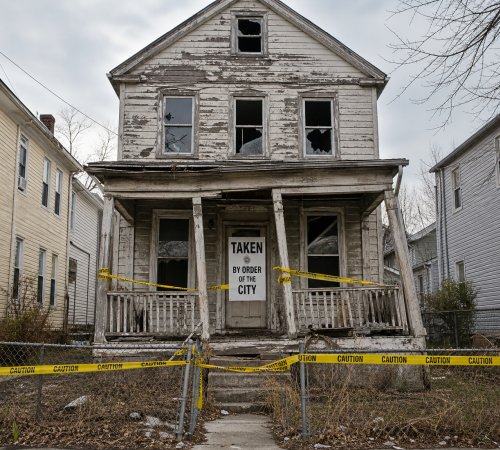
You own a building in New York City. The City says: this is unsafe building. You got some violation notices from DOB* in the past. Maybe you ignored them. Maybe you planned to fix things later. Then one day you get a court paper. It says the City now has the right to walk into your building and do the work themselves. That paper is called a Precept.
If you do not know this word, you are not alone. Many property owners — especially those who are new to the United States or new to owning property — have never heard it before. This article explains what a precept is, in simple language, so you can understand what happened and what comes next.
When the City Takes Over Your Unsafe Building: What a Precept Really Means for NYC Homeowners
WHAT IS A PRECEPT?
A precept is a special court order. A judge signs it. It gives the City of New York — usually through the agency called HPD* (Housing Preservation and Development) — the legal right to enter your property and do emergency or required work.
Think of it this way:
- You had a problem in your building (unsafe structure, dangerous conditions, housing code violations).
- The City told you to fix it.
- You did not fix it — or you could not fix it fast enough.
- The City went to court.
- The judge agreed with the City.
- The judge signed the precept.
- Now the City can come in and do the work without your permission.
Next step: check if Categories and Tags need to be adjusted.
Now there is text to be inserted: Hello I’m in NYC and I’ve been informed that the work to upgrade my electrical panel might be in violation of city code and was not performed with a permit.
Seeing as I’ve already paid 50% for the work, and not having an idea of what I’m looking at, I’m trying to ascertain if there is indeed a problem
The work is not done up to Coned and DOB National Code requirements There are no weatherproof fittings There is a custom-made knockout in meter pan enclosure Each new installation requires confirmation of the placement raintight weather head etc Connectors to the main line with unapproved bite connectors
WHAT KINDS OF WORK CAN THE CITY DO UNDER A PRECEPT?
The City can do many things depending on the situation. Common examples include:
- Sealing a building that is empty and dangerous
- Shoring up walls or floors that could collapse
- Demolishing part of the building — or in serious cases, the whole building
- Making emergency repairs to stop a dangerous condition
The work the City does depends on how serious the problem is. A small unsafe condition may result in limited repairs. A very dangerous or abandoned building may result in full demolition.
THE PART THAT SURPRISES MANY OWNERS: THE BILL
Here is the part that shocks many property owners.
After the City does the work, they send you the bill.
Yes — even though the City forced their way in and did the work without your involvement, you are still responsible for paying for it.
If you do not pay, the City can place a lien on your property. A lien is a legal claim attached to your building. It means:
- You cannot sell the building without paying off the lien first.
- The lien grows over time because interest is added.
- In serious cases, the lien can lead to the City eventually taking ownership of your property.
This is one of the most important things to understand: a precept is not the end of the story. The financial consequences come after.
HOW DOES A PROPERTY END UP WITH A PRECEPT? (A REAL-LIFE SCENARIO)
Here is a simple example of how this can happen:
Maria owns a two-family house in Brooklyn. She receives an Unsafe Building notice from DOB — the Department of Buildings. The notice says the rear wall of the building is cracked and dangerous.
Maria does not respond. She does not hire a contractor. She does not file anything with DOB.
DOB escalates the case. HPD gets involved because the building has tenants. The case goes to Housing Court.
At Housing Court, the judge decides the situation is urgent. The judge signs a precept. HPD hires a contractor and shores up the rear wall. The work costs $18,000.
HPD sends Maria an invoice. Maria does not pay. The City places an $18,000 lien on her property, plus interest.
Two years later, Maria tries to sell the house. The buyer’s attorney finds the lien during the title search. The sale cannot close until Maria pays the full lien amount — now $21,500 with interest.
This is not unusual. It happens regularly in New York City.
WHAT SHOULD YOU DO IF YOU RECEIVE A PRECEPT OR A RELATED COURT NOTICE?
If you receive any court paper related to your building — especially one mentioning a precept, an unsafe building order, or HPD enforcement — do the following immediately:
- Read the paper carefully. Look for dates and deadlines.
- Do not ignore it. Court papers always have consequences if you do nothing.
- Contact a qualified contractor or architect who knows NYC DOB and HPD procedures.
- Consider speaking with a lawyer who handles NYC building code or real estate matters.
- Check your property’s violation and lien status on the NYC Department of Finance and HPD websites.
The earlier you act, the more options you have. Once the City has already done the work, your options become much smaller.