Unsafe Building Terminology and Structural Violations
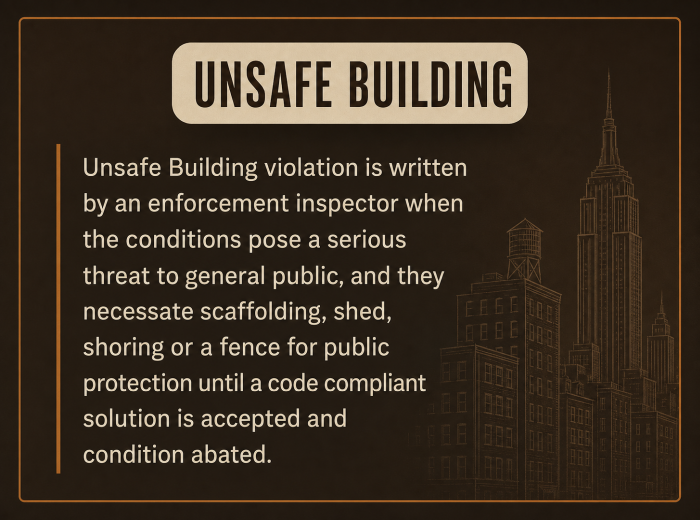
An unsafe building is a building, or part of a building, that the New York City Department of Buildings (DOB) determines is dangerous to people or property. The danger may result from severe damage, structural instability, falling materials, fire damage, or another hazardous condition.
When DOB declares a building unsafe, the owner may be required to act immediately. Required work can include securing the site, making repairs, installing temporary supports, removing dangerous conditions, or demolishing part or all of the structure.
If the owner does not take the required action, the City may perform emergency work. The City can charge the owner for that work and may place a lien against the property.
What an Unsafe Building Designation Means
DOB may determine that a building is unsafe when it is severely damaged, structurally unstable, open and unprotected, vacant and poorly maintained, or otherwise likely to harm people or nearby property. An unsafe condition can endanger residents, neighbors, pedestrians, and workers.
The owner will generally receive a notice, order, or violation identifying the condition and the work required. Depending on the situation, the owner may need to hire a licensed architect or professional engineer, obtain permits, secure the property, and complete repairs by DOB’s deadline.
Failure to address an unsafe condition can lead to additional violations, civil penalties, court action, a Stop Work Order, a Vacate Order, emergency work by the City, or demolition in severe cases.
Common Unsafe Conditions
- Cracked, leaning, deteriorated, or failing walls, foundations, floors, columns, or other structural supports
- Loose façade materials, bricks, parapets, balconies, or other falling debris hazards
- Fire, water, storm, impact, or other damage that weakens the structure
- A collapsed or partially collapsed roof, wall, floor, stairway, or other structural component
- A vacant building that is open, unsecured, deteriorated, or not properly maintained
What DOB May Do
If DOB determines that a building is unsafe, it may require the owner to protect the public and correct the condition. If the owner does not act, the City may secure, repair, or demolish the building and seek reimbursement from the owner.
Structural Violations and Unsafe Building Status
Serious structural conditions are often cited as Class 1, Immediately Hazardous violations. Depending on the facts, DOB may also identify a building as potentially compromised because of major damage, prolonged weather exposure, prior shoring or bracing, fire damage, or another condition that may affect structural stability.
Structural violations receive close attention because they can create a risk of collapse, falling debris, or other serious harm. Under NYC Administrative Code §28-216.1, a building or part of a building may be considered unsafe when it is, or may become, dangerous to life, health, safety, or property.
A structural violation does not automatically result in a formal Unsafe Building (UB) designation. However, a serious condition may lead DOB to begin the unsafe building process, require emergency protective measures, or issue additional enforcement orders.
A Typical Escalation Path
- An inspection identifies a structural issue, such as cracked foundation walls, deteriorated façade elements, incomplete or unstable exterior walls, or compromised load-bearing components.
- DOB may classify the condition as Class 1, Immediately Hazardous, when it presents a serious risk to life or safety.
- If DOB determines that the building may be structurally compromised, it may require further inspection, monitoring, shoring, bracing, or other protective measures.
- Where the potentially compromised building requirements apply, the owner may need to arrange a structural inspection and submit a report to DOB within the deadlines established by law or by DOB.
- If the inspecting design professional finds an unsafe condition that threatens structural integrity, they may have reporting obligations and DOB may issue or expand enforcement actions.
- Construction-related conditions, such as inadequate shoring, unsafe excavation support, or unstable scaffolding, can also result in a Stop Work Order until the hazard is corrected.
Possible DOB Actions
- Inspect the property and document the hazardous or unsafe condition
- Issue a DOB violation, Unsafe Building order, commissioner’s order, or other enforcement notice
- Require fencing, sidewalk protection, scaffolding, shoring, bracing, or other safety measures
- Require evaluation, plans, or supervision by a licensed architect or professional engineer
- Require permits and corrective work by a stated deadline
- Issue a Stop Work Order when construction work creates or worsens a hazardous condition
- Issue a Vacate Order when people cannot safely remain in all or part of the building
Authorization for Temporary Residence (ATR)
In some unsafe building cases, DOB or another City agency may issue an Authorization for Temporary Residence (ATR). An ATR may allow people to remain in or return to a building on a temporary and conditional basis while required work is completed.
An ATR is not permanent authorization to occupy the building. Occupancy is allowed only while the owner follows every condition, safeguard, and deadline stated in the authorization.
What an ATR Means for a Homeowner
- The building has an unsafe condition or unresolved safety concern, but temporary occupancy may be allowed under stated conditions.
- Residents may remain only in the areas and under the conditions permitted by the ATR.
- The owner must complete the required repairs and safety measures by the listed deadlines.
- The City may revoke or modify the ATR if the owner misses a deadline or fails to comply with a condition.
- If temporary occupancy is no longer considered safe, DOB or another agency may issue a Vacate Order.
What to Do if Your Building Receives an ATR
- Read the ATR, all attached conditions, and every listed deadline carefully.
- Contact a licensed architect or professional engineer promptly if the required work involves structural, façade, fire-damage, or other technical safety issues.
- File all required DOB applications and permits before beginning regulated work.
- Track each deadline and retain proof that required work and filings were completed.
- Keep photographs, inspection reports, permits, invoices, correspondence, and copies of all City notices.
- Confirm with the appropriate City agency when the conditions have been satisfied and whether the building record has been updated.
ATR Compared With a Vacate Order
| Issue | Authorization for Temporary Residence (ATR) | Vacate Order |
|---|---|---|
| Can people stay in the building? | Possibly, but only temporarily and only if all conditions are followed. | No. People must leave the affected area or building until the order is lifted. |
| Are conditions attached? | Yes. The authorization may include safety requirements, repair obligations, and deadlines. | Yes. Required corrective work must generally be completed before reoccupancy. |
| Are repair deadlines required? | Yes, where stated in the ATR or related orders. | Often, depending on the order and the corrective work required. |
| Can the status change? | Yes. The ATR may be revoked, modified, or allowed to expire if conditions are not met. | Yes. The order may be rescinded or modified after the required work is completed and accepted. |
What Property Owners Should Do
- Read every DOB notice, order, violation, and deadline carefully.
- Secure the building immediately when required, especially where there is a risk to occupants, pedestrians, or neighboring property.
- Consult a licensed architect or professional engineer when a professional evaluation, structural analysis, repair plan, or filing is required.
- Obtain required DOB permits before performing regulated work.
- Keep photographs, reports, permits, invoices, proof of corrective work, and all communications with the City.
- Check DOB NOW and, where applicable, BIS records for Unsafe Building (UB) violations, related orders, permits, and case-specific instructions.
In simple terms: An unsafe building designation means that DOB believes the building, or part of it, presents a serious safety concern. The owner must act quickly to protect people, correct the condition, and comply with all applicable DOB orders. Failure to do so can lead to additional violations, penalties, emergency work performed by the City, and, in severe cases, demolition.

NEXT STEP
See how illegal conversions can leads to: some examples
Good to know
This page is for general education only and is based on public New York City sources when available. Some technical and legal terms are simplified into plain English to help homeowners and ESL readers. It is not legal advice, and it does not replace guidance from a licensed professional. NYC construction and safety rules change often, and your project may have extra DOB, OSHA, or local requirements. Before you start work, always check current rules with a licensed design professional or directly with the NYC DOB*.
Feel free to comment on this post
This is an advertisement box

If you see any capital letter abbreviations on this page or in an official letter you received from the city and you do not understand them, you can try to look them up on our NYC Violation Codes HUB page with the search tool.
Revised